

The myth that WordPress is a platform for bloggers and small businesses still permeates the air of the CMS world, but used by large enterprises such as Playstation, Mercedes Benz and even The White House, this assumption is well and truly incorrect.
In this post, we outline why enterprise companies should consider using WordPress, and how utilising a headless WordPress CMS could benefit your business in our multi-device world.
First, what exactly is a headless CMS?
Whilst it all sounds a bit sinister, a headless CMS is anything but that.
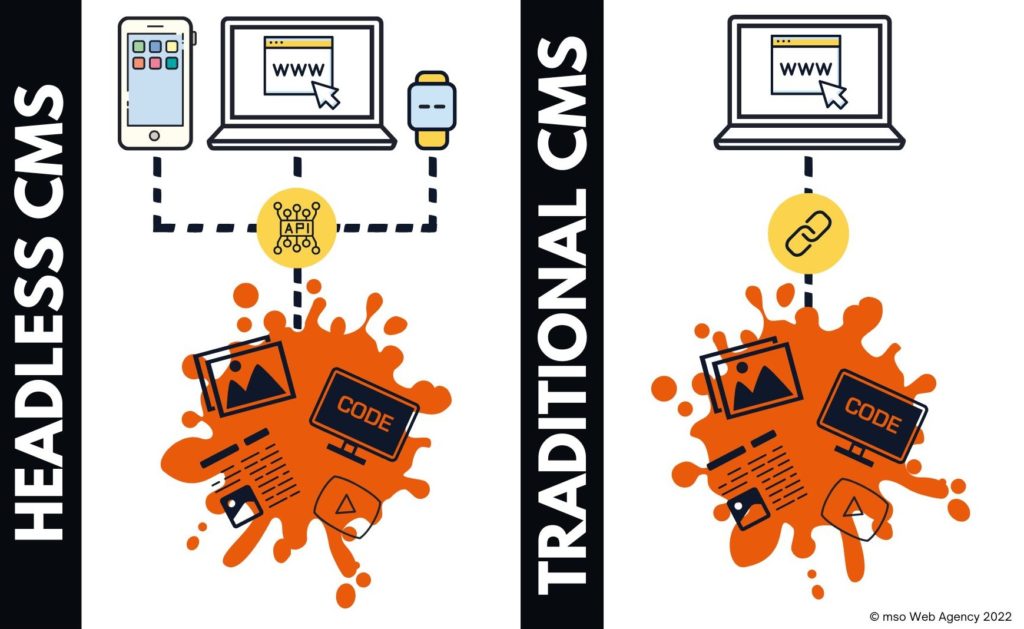
It’s essentially a content management system where the website content (the “body”) is stored separately from where it is presented (the “head”) as opposed to a traditional CMS where the content repository is tightly integrated with the frontend.
We spoke with our Managing Director, George Broom, on the benefits of utilising a headless CMS:
 A headless CMS is highly versatile and as such can be used in a number of ways.
When you separate the “frontend” presentation from the “backend” content repository, you eliminate the need to have a frontend that is reliant on your CMS.
So for headless instances, when the “frontend” is loaded, a request is sent to the “backend” content repository via an API to pull in the content from the headless CMS to populate the frontend.
This setup enables you to use the same CMS content in multiple locations or websites, by utilising different API requests from each of those frontend platforms, be it the website, an app, a smart watch or even front-of-house bulletin boards.
Ultimately, the benefits of this set-up include;
Increased security – As the frontend and backend of a CMS are not directly connected, there’s only one endpoint to access your data. This means that even if a hacker has access to your content database, they cannot take the ‘frontend’ e.g. website or app down.
Quicker website speed – This is integral in creating a positive user experience and improving SEO performance. As the content is stored separately from the frontend, there’s less code to load, which means quicker load times.
It’s flexible – As previously mentioned, the content can be managed via a central repository and deployed via an API to multiple platforms. This negates the need to have multiple CMS’ serving different channels, which can lead to brand inefficiencies.
Do you think headless CMS’ are the future?
In my opinion, the ease and efficiency of deploying channel-specific content, the increased security and the flexibility and scalability of a headless CMS would be of great benefit to many enterprises.
But as is the case with any new technology, it’s always important to consider if a headless CMS is the right fit for your organisation.
Looking at reports on the matter, the consensus according to WP Engine: The State of Headless Global Research Report is that the headless CMS approach is at the forefront of the minds of many enterprises already:
“Among enterprise organizations not currently using headless, more than 90% plan to evaluate headless solutions over the next 12 months—up 15% from 2019.”
So we expect more and more enterprises to adopt the headless approach in the not-so distant future.
But why would we advise choosing WordPress for your enterprises CMS, headless or otherwise?
What can you do with a Headless WordPress CMS?

First and foremost, perhaps the best thing that you can do with a Headless WordPress CMS is future-proof your content.
Rather than focusing on how the back-end admin will feed the front-end design, you’re creating an API-first system where content can be called forth cross-devices via an API endpoint.
This gives you greater flexibility when it comes to migrating your content as it’s not so heavily intertwined with the themes and plugins that you would otherwise experience in a traditional CMS.
A Headless CMS also gives you greater control from a development perspective. You’re essentially taking the reins off of your front-end developers and allowing them the possibility to be creative with their use of code to create a fully bespoke web experience that offers enhanced performance.
You will also have tighter security with the Headless WordPress CMS. Both the content and front-end are separate entities, so it’s not as exposed as its traditional CMS counterpart.
You can benefit from increased scalability, extremely important for large enterprises who are consistently evolving. Whether this be the introduction of new functionality or responding to data concerning consumer experience or expectations, you can update your digital offering efficiently and effectively.
Going headless should improve load-times. Since you’re just presenting a content database and an API call, this should improve load times significantly offering an experience that’s sleek and fast.
Our takeaways…
As alluded to above, the decision whether to use the traditional WordPress CMS, or Headless WordPress CMS for your enterprise is subject to the requirements of your organisation.
With its popularity as a viable option to support innovation, and multi-platform content management, we believe it will certainly prove an excellent option for cross-channel marketing for any enterprise looking to improve the efficiency of their digital offering.
If you have any questions on WordPress, whether headless or otherwise, get in touch with our Marketing and Business Development Manager, Sam Meade [email protected], or by calling 01474 704400.
Alternatively, you can brush up on the Key features of a WordPress website here.